

Get your Civil Service application through the sift
STAR statements from your own CV, in under 10 minutes, not a weekend.
Paste the job advert
- Free to start
- No account needed
- One statement free before you pay
Everything from the job description to the application instructions. On Civil Service Jobs, select all (Ctrl+A or ⌘A), copy and paste; a link from another job site we read for you.
From one line of your CV to a statement the panel scores
Your CV says what you did. The sift scores how you did it. You answer a few short questions; we turn the answers into a STAR statement at the advert's grade and word limit.
• Introduced a shared tracker for refund requests
In my last role, customer refund requests were tracked in three separate spreadsheets, and requests regularly went missing. I suggested a single shared tracker and asked my manager for two weeks to trial it. I built the tracker with a status column and a weekly check, wrote a one-page guide and showed each colleague how to use it, listening to their concerns about extra admin. Two colleagues worried about duplicate entries, so I added a simple rule that the first person to log a request owns it. After the trial, missed requests fell from around ten a month to none, and the team adopted the tracker permanently. I now ask the people doing the work what slows them down before I suggest a change.
What you get
The whole application for one advert, on one page, ready to finish and paste into Civil Service Jobs.
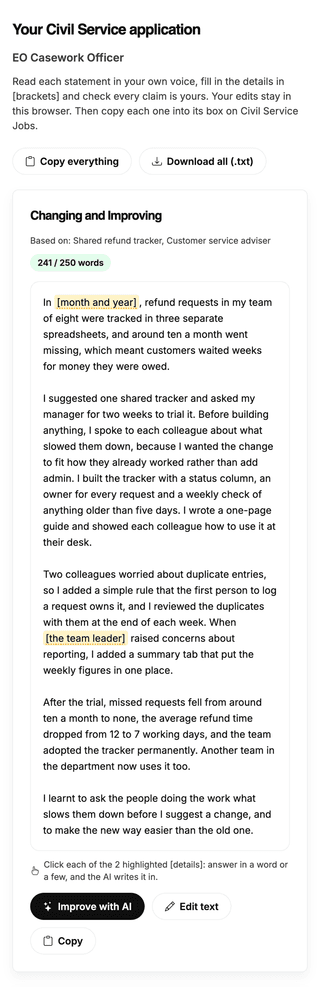
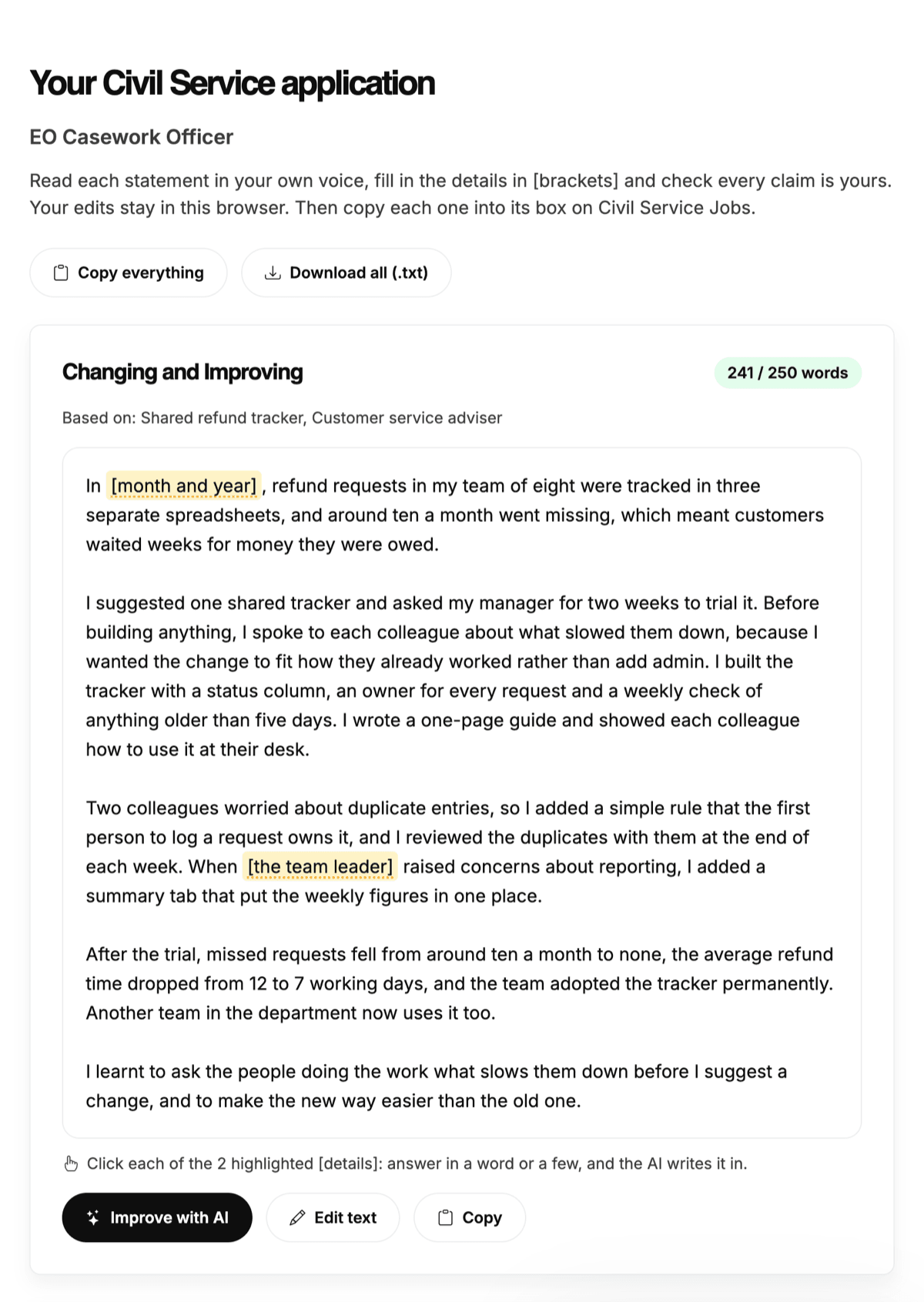
A statement for every behaviour
One STAR example per behaviour the advert asks for, pitched at its grade and kept within its word limit, with a live word count.
A personal statement, criterion by criterion
Evidence for each essential criterion, in the advert's order, within its word limit.
Your examples, nothing invented
Built from your CV and your answers. A detail we do not know stays in a highlighted [bracket]: click it, answer in a few words, and the AI writes it in.
Finish it with the AI
Ask for any change (shorter, more "I", a stronger result) as many times as you like, or edit the text yourself.
Copy it, or download it
Copy each statement into its box on Civil Service Jobs, or download the whole application as a text file. Your link works for 30 days.
- 4 behaviour statements250 words each, in STAR
- 1 personal statement750 words, criterion by criterion
- Notes on what to checkbefore you submit
- Changes with the AIas many as you need, for 30 days
Applying for several roles? The Job Search Pack ($29) includes every Civil Service application, with no daily limit.
How it works
Paste the advert or its link. We read the grade, the behaviours, the essential criteria and the word limits.
Add your CV, or build one in a short chat, and answer a few questions about how you did things.
Read one statement in full for free. Unlock the whole application for $14.90, paid once, and finish it with the AI.
Every example comes from your CV and your answers; missing details are left in [brackets] for you, as the Civil Service guidance on AI expects.
Built for the sift, not for any text
A general chatbot writes whatever you ask for. A Civil Service panel scores what you did, at the advert's grade, within its word limit, and the Civil Service rules out invented or generic answers. Here is the difference with the same advert and CV.
It reads the advert for you
ChatGPT: Paste the advert and hope it picks out the right behaviours, the grade and the word limits.
Here: The grade, behaviours, essential criteria and word limits are read into a form you check before anything is written.
It asks before it writes
ChatGPT: Writes straight away from whatever you gave it, so the "how" the panel scores is guessed.
Here: Picks the best situation in your CV for each behaviour and asks two or three questions about how you handled it.
Nothing made up
ChatGPT: Fills gaps with numbers and results that sound right but never happened: the false information the Civil Service rules out.
Here: A detail you have not given stays in a highlighted [bracket] until you answer it.
Within the word limit
ChatGPT: Miscounts words, so you trim by hand and lose the result at the end.
Here: Every statement is written to the advert's limit, with a live word count as you edit.
Pitched at the grade
ChatGPT: Writes the same example for an EO post as for Grade 7.
Here: Pitches each example at the Success Profiles level for the advert's grade.
Ready to paste
ChatGPT: One long reply to split up, check against the criteria and reformat yourself.
Here: A statement per behaviour and the personal statement criterion by criterion, each with its own copy button.
How Civil Service applications are scored
Most adverts on Civil Service Jobs use Success Profiles. At the application stage that usually means a personal statement against the essential criteria, behaviour statements, or both, each scored by a panel against what the advert asked for.
Behaviour statements: STAR in about 250 words
Each behaviour is one example of something you did. Spend little on the situation and the task, most of the words on your actions (what you did, how and why) and end on the result: what changed, ideally with a number, and what you learnt.
- Situation and task: about 15%
- Action: about 65%, in "I", not "we"
- Result and learning: about 20%
Personal statement: evidence for every criterion
Also called a statement of suitability. The panel checks it against the essential criteria in the advert, usually in 250 to 1,250 words. Take the criteria in order, give each one a concrete example, and leave out lines that could be about anyone.
A criterion you give no evidence for scores nothing, however strong the rest is.
Pitch each example at the grade
The same behaviour is assessed at a different level for each grade, so an example that wins at EO can look thin for a Grade 7 post.
| Grades | Level | What your examples should show |
|---|---|---|
| AA, AO | 1 | Doing your own work well, following procedures, helping colleagues and the public. |
| EO | 2 | Organising your own work and sometimes others', improving a process, dealing with stakeholders directly. |
| HEO, SEO | 3 | Leading a piece of work or a team, deciding with incomplete information, influencing across teams. |
| Grade 7, Grade 6 | 4 | Leading teams and programmes, shaping policy or a service, managing senior stakeholders and budgets. |
| SCS | 5 | Leading an organisation, setting strategy across departments, accountable for major outcomes. |
Civil Service behaviours, with an example of each
What the panel looks for in each of the nine behaviours, and a fictional example that shows the shape of a strong answer. Yours has to be your own: a copied example is exactly what the Civil Service rules out.
Seeing the Big Picture
That you understand why your work matters to the department's aims and the public, and that you act on it rather than only following instructions.
Seeing the Big Picture
That you understand why your work matters to the department's aims and the public, and that you act on it rather than only following instructions.
When the department announced a move to digital-first claims, I led a review of how my team's paper process would be affected. I read the strategy and spoke to the policy team to understand what it was meant to achieve: faster decisions for claimants and lower handling costs. I mapped our 14 manual steps against it and found three that would still need paper because of a legal signature requirement. Rather than wait for the national design, I proposed a short interim process to my Grade 7, with the risks set out, and briefed my team on why the change mattered for claimants. The interim process went live a month before the national system and cut our average decision time from 12 to 8 days. I learnt to read a policy for its purpose, not just its instructions.
Changing and Improving
A change you started or made work: what was wrong, how you tested a better way, and how you brought people with you.
Changing and Improving
A change you started or made work: what was wrong, how you tested a better way, and how you brought people with you.
In my last role, customer refund requests were tracked in three separate spreadsheets, and requests regularly went missing. I suggested a single shared tracker and asked my manager for two weeks to trial it. I built the tracker with a status column and a weekly check, wrote a one-page guide and showed each colleague how to use it, listening to their concerns about extra admin. Two colleagues worried about duplicate entries, so I added a simple rule that the first person to log a request owns it. After the trial, missed requests fell from around ten a month to none, and the team adopted the tracker permanently. I now ask the people doing the work what slows them down before I suggest a change.
Making Effective Decisions
How you gathered and weighed evidence, who you consulted, the options you considered and why you chose one, and that you explained it openly.
Making Effective Decisions
How you gathered and weighed evidence, who you consulted, the options you considered and why you chose one, and that you explained it openly.
As project lead for a supplier contract renewal, I had six weeks to recommend whether to extend the existing contract or go to tender. I gathered two years of performance data, spoke to the three teams who used the service, and asked commercial colleagues about the market. The data showed the supplier met 92% of its targets but its costs had risen 18%. I set out both options with their costs, risks and impact on users, and tested my analysis with finance before it went to the board. I recommended a one-year extension with tighter targets while we prepared a tender, and explained the trade-off openly. The board agreed, saving an estimated £40,000 against an immediate tender, and the tender launched on schedule the following year.
Leadership
That you set a clear direction, involved people in it, valued their differences and kept them motivated, whether or not you manage anyone.
Leadership
That you set a clear direction, involved people in it, valued their differences and kept them motivated, whether or not you manage anyone.
When I took over a team of eight after a restructure, morale was low and two people had asked to move. I met each person individually to understand their concerns, then agreed a clear set of priorities with my Deputy Director so the team knew what mattered and why. I set up a fortnightly session where anyone could raise problems, and made sure quieter colleagues had the chance to lead parts of it. When a colleague with caring responsibilities struggled with meeting times, I moved our core meetings to the middle of the day. Within six months the team's staff survey engagement score rose from 48% to 71%, nobody left, and we delivered all four of our business plan commitments. I learnt that people follow a direction they helped to shape.
Communicating and Influencing
That you understood your audience, chose how to put your message across, handled objections with respect and changed what people did.
Communicating and Influencing
That you understood your audience, chose how to put your message across, handled objections with respect and changed what people did.
I needed to persuade regional managers to adopt a new reporting template that they saw as extra work. Before the meeting, I spoke to two of them to understand their objections: the time it took, and reports they felt nobody read. I cut the template from four pages to one, and prepared a short example showing how their figures would be used in the monthly briefing to ministers. In the meeting I started with the problem the template solved for them, answered concerns directly and agreed a one-month trial. I followed up in writing with a summary and a named contact. Nine of the eleven regions used the template in the first month and all eleven by the third, and I shared the ministerial briefing back so they could see the result.
Working Together
Relationships you built beyond your own team, how you shared knowledge and helped others, and a shared result.
Working Together
Relationships you built beyond your own team, how you shared knowledge and helped others, and a shared result.
During a peak in casework, our team and the neighbouring team were both falling behind, and we were competing for the same specialist adviser's time. I suggested to both managers that we share a single queue for questions to the adviser, and offered to set it up. I agreed simple rules with colleagues from both teams so the most urgent cases went first, whoever raised them, and I put my own notes on common questions on our shared drive so people could answer simpler queries themselves. Over the next two months, the wait for an answer from the adviser fell from five days to two, and both teams cleared their backlog before the deadline. Several colleagues added their own notes to the guide, and it is still in use.
Developing Self and Others
What you set out to learn and how, and how you helped colleagues grow, with a change you can point to.
Developing Self and Others
What you set out to learn and how, and how you helped colleagues grow, with a change you can point to.
When our team began using data dashboards, I realised that neither I nor most of my colleagues could build or read them confidently. I completed the department's online data course and practised on our own team's figures. I then ran short lunchtime sessions, starting with what each person needed for their own work. I paired with two less confident colleagues and built their first dashboards alongside them, then stepped back so they could do it on their own. Within three months, five of the seven team members were producing their own monthly dashboards, saving our analyst about a day a month. One of the colleagues I supported went on to a data role. I keep a list of the skills I want to build next and review it with my manager each quarter.
Managing a Quality Service
That you put the people using a service first: you found out what they needed, planned how to deliver it, kept to the rules and improved it.
Managing a Quality Service
That you put the people using a service first: you found out what they needed, planned how to deliver it, kept to the rules and improved it.
I answered written enquiries from the public, and complaints showed that people found our replies hard to understand. I read a sample of 50 replies and the complaints about them, and found that most problems came from technical terms and missing next steps. I drafted plain English templates for the ten most common enquiries, each ending with what happens next and when, and tested them with two colleagues and a member of our public feedback panel. I agreed the wording with my manager and our policy lead so it stayed accurate. After three months, complaints about clarity had fallen by 60%, and the average time to reply dropped from ten days to six because fewer people wrote back asking what we meant.
Delivering at Pace
Clear ownership of a result under time pressure: how you planned and prioritised, kept others informed, dealt with setbacks and still delivered to standard.
Delivering at Pace
Clear ownership of a result under time pressure: how you planned and prioritised, kept others informed, dealt with setbacks and still delivered to standard.
Two weeks before a statutory deadline, a colleague left unexpectedly and I took on her 120 cases on top of my own. I listed every case by deadline and complexity, agreed with my manager which lower-priority work could pause, and set myself daily targets. I cleared the simpler cases first in focused blocks, flagged the 15 complex ones early so a senior colleague could take two of them, and updated my manager every morning on progress and risks. When a system outage cost me a day, I adjusted the plan and paired with a colleague to check each other's cases quickly. All 120 cases were completed before the deadline, with no errors found in the quality check. I learnt that early, honest updates make it much easier to get help in time.
Questions applicants ask
Am I allowed to use AI for a Civil Service application?
The Civil Service's own guidance for candidates allows AI to help you present your real experience, for example to structure an example in STAR or keep it within the word limit. It must not be used to give false information or to paste in generic answers. That is how this tool works: it writes only from your CV and the examples you give it, leaves missing details in [brackets] for you, and you read and check every word before you submit.
Why not just use ChatGPT?
You can, but a general chatbot writes from whatever you give it: it does not read the advert's grade, behaviours and word limits for you, does not ask how you handled each situation, miscounts words, and fills gaps with results that never happened, which is the false information the Civil Service rules out. This tool is built for the sift: it reads the advert, asks two or three questions per behaviour, pitches each example at the grade, keeps it within the word limit and leaves anything you have not told it in [brackets] for you.
Will it make up examples or results?
No. Every example, number and result comes from what you paste in. Where a detail would make a statement stronger but you have not given it, the statement says so in [brackets], for example [how many cases a week], and lists it as a question for you to answer. If your CV has no evidence for one of the essential criteria, the notes tell you what kind of example to look for instead of inventing one.
What do I get for the price?
For one advert: the personal statement (statement of suitability) and a statement for each behaviour you choose, up to six, each written to the advert's word limit and pitched at the grade. Every statement opens with its word count, ready to copy into Civil Service Jobs, with notes on what to check. You then finish each one with the AI: click a detail in [brackets] and answer in a word or two, or ask for any change in your own words ("shorter", "add that I trained two new starters"), as often as you need. One payment, no subscription, and the link works for 30 days. Applying for several roles? The Job Search Pack includes every Civil Service application, with no payment per advert.
Which grades does it work for?
From Administrative Assistant to the Senior Civil Service. The behaviours are assessed at different levels for different grades, so tell the tool the grade from the advert and it pitches each example at that level: your own work at AA and AO, organising and improving at EO, leading pieces of work at HEO and SEO, setting direction at Grade 7 and Grade 6.
What happens to my CV?
It is sent to our AI provider to write your statements and is not saved with your application. We keep the advert and the statements written for it, so your link works. Payments are handled by our payment provider, Lemon Squeezy; we never see your card details.
Can I reuse my statements for another job?
A strong example often works for the same behaviour in another application, but each advert asks for something slightly different: other essential criteria, another grade, another word limit. Paste the new advert and the tool writes to it; the edits you made to your earlier statements stay in your browser.
Your next application, ready in under 10 minutes
Every grade from Administrative Assistant to the Senior Civil Service. One payment of $14.90 per advert, no subscription.
InMyResume is an independent writing tool. It is not part of, or endorsed by, the UK Civil Service or Civil Service Jobs.
Applying to the NHS as well? Write your NHS supporting statement the same way, from the same CV.