

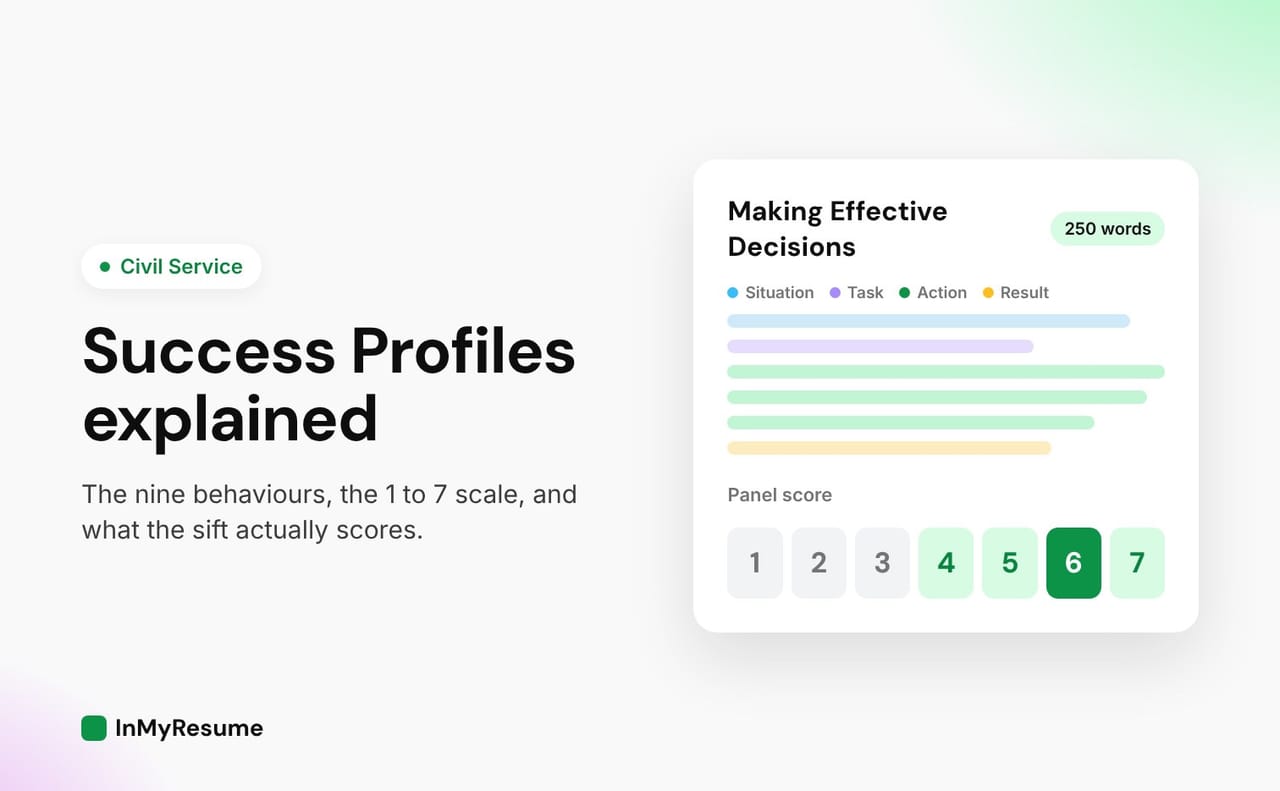
The five elements of Success Profiles, the nine Civil Service behaviours, how statements are scored from 1 to 7, and the reasons strong candidates are sifted out.
Almost every job on Civil Service Jobs is advertised against Success Profiles, the framework the UK Civil Service uses to decide who gets an interview and who gets the job. If you have applied before and heard nothing back, the reason is usually not your CV: it is that the sift scored what the advert asked for, and the application did not give the panel enough to score.
This guide explains what Success Profiles are, which parts are assessed at the application stage, and how the panel turns your statements into a number.
The five elements of Success Profiles
Success Profiles replaced the old competency framework in 2019. Instead of one list of competencies, each vacancy picks from five elements:
- Behaviours: the actions and activities that lead to effective performance in the job, such as Making Effective Decisions or Delivering at Pace.
- Experience: the knowledge and achievements you bring from previous roles, usually assessed through a CV and a personal statement.
- Technical: professional skills or qualifications the job needs, such as a legal or accountancy qualification.
- Ability: aptitude for the role, often tested online (verbal, numerical or judgement tests).
- Strengths: what you enjoy and do regularly. These are almost always assessed at interview, with questions you cannot prepare word for word.
The advert tells you which elements it uses and, crucially, which of them are assessed at the application stage. That line is the most important one in the advert: it is your marking scheme.
The nine Civil Service behaviours
There are nine behaviours, and an advert typically names three to six of them:
- Seeing the Big Picture
- Changing and Improving
- Making Effective Decisions
- Leadership
- Communicating and Influencing
- Working Together
- Developing Self and Others
- Managing a Quality Service
- Delivering at Pace
Each behaviour is described at five levels, which line up with grades: level 1 for AA and AO, level 2 for EO, level 3 for HEO and SEO, level 4 for Grade 7 and Grade 6, and level 5 for the Senior Civil Service. The same behaviour asks for something different at each level, so an example that is strong for an EO post can look thin for a Grade 7 one. Read the indicators for your grade in the Success Profiles guidance on GOV.UK before you choose your examples.
How the sift scores your application
At the application stage you usually write a behaviour statement for some of the behaviours (often 250 words each), a personal statement against the essential criteria (often 250 to 1,250 words), or both. Many departments sift without your name, so the panel sees only what you wrote.
Each statement is scored on a seven-point scale, from 1 (insufficient evidence) to 7 (outstanding). Campaigns set their own pass marks, but a score of 4 (moderate evidence) on each behaviour is a common minimum. What moves a score up is not polish; it is evidence:
- One specific example, not a summary of your career.
- Your actions, in "I": what you did, how and why. The panel cannot score what "we" did.
- A result, ideally with a number, and what you learnt.
- Pitched at the grade: the scope of the example matches the level the advert asks for.
The usual way to fit all of that into 250 words is STAR: a short Situation and Task, most of the words on your Action, and a clear Result. In practice that is roughly 15% situation and task, 65% action and 20% result.
Common reasons strong candidates are sifted out
- Writing about the team. "We reduced the backlog" gives the panel nothing to score. Say what you did.
- Answering the wrong behaviour. An example of hard work is not an example of Changing and Improving. Check the behaviour's indicators and make sure your example shows them.
- No result. A statement that stops at the action usually scores lower than one with an outcome.
- Going over the word limit. The online form cuts you off, and the end of your statement is usually the result.
- Generic or copied text. The Civil Service's guidance on AI in recruitment allows AI to help you present your real experience, but not to invent it or to produce answers that are not your own.
Turning your CV into scoreable statements
Your CV says what you achieved; the sift scores how you did it. The fastest way to close that gap is to take one line of your CV per behaviour and ask yourself three questions: what exactly was the problem, what did I do step by step, and what changed as a result. Those answers are your statement.
If you would like help with that, the Civil Service application writer reads the advert's grade, behaviours, essential criteria and word limits, picks the best example in your CV for each behaviour, asks you how you handled it, and writes STAR statements and a personal statement within the limits. Anything it does not know stays in [brackets] for you to fill in, so every word is your own experience.
Next, read how to write a Civil Service personal statement, the other half of most applications.